


Description
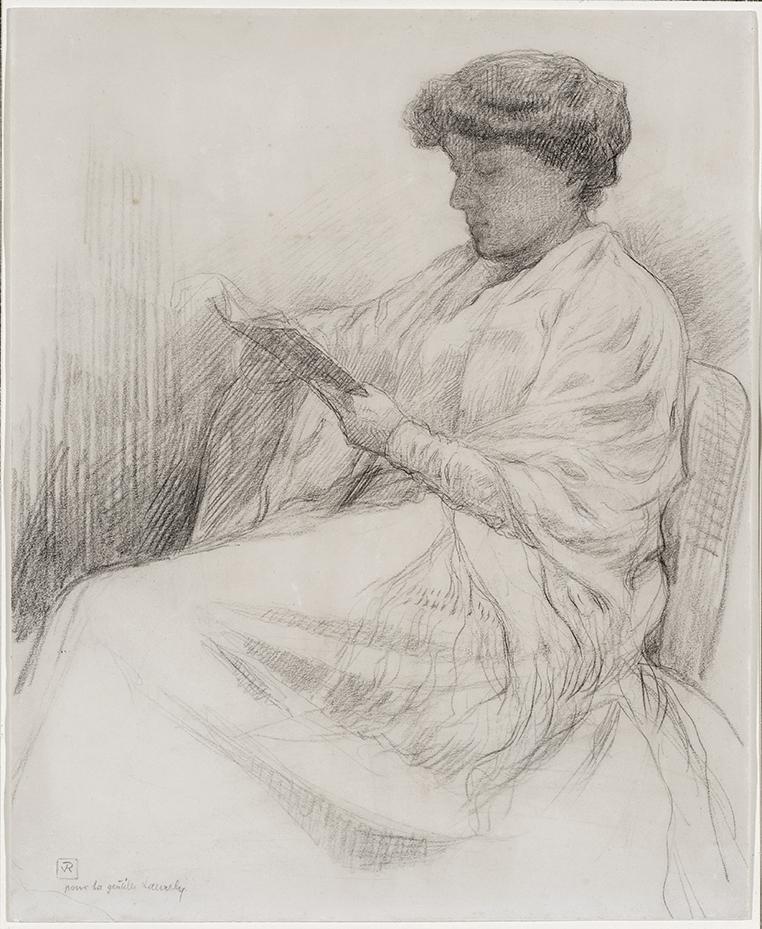
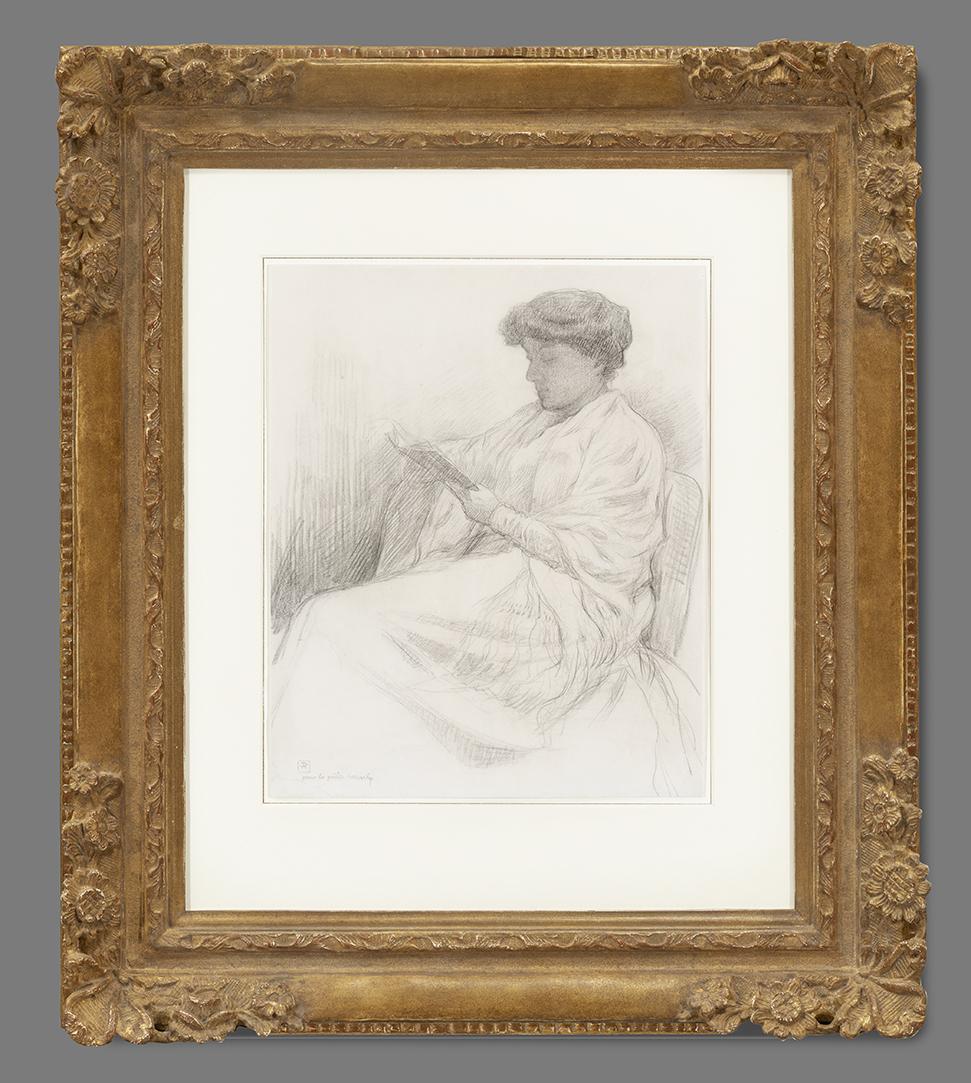
This refined drawing shows Laure Flé seated in an armchair, absorbed in her reading. Van Rysselberghe constructs her with a delicate yet assured line, allowing the pose to emerge from a haze of quick, parallel strokes. Her concentration is emphasized by the inward turn of the head and the firm, elegant gesture of the hand holding the book. Background and seat are indicated with a few vertical and diagonal hatchings, keeping the focus on the tranquil rhythm of the drapery and the graceful curve of the sitter’s silhouette.
Van Rysselberghe evokes the quiet, bourgeois interior and the refined world of letters that so often surrounded his circle of writers and intellectuals. The result is a portrait of introspection rather than display, capturing a fleeting, private moment instead of a formal likeness.
The sitter is Laure Flé, an opera singer and the wife of composer Georges Flé. During the summer holidays, the couple often welcomed artists, including Van Rysselberg on several occasions, at their villa in Ambleteuse on the Opal Coast in Pas-de-Calais. The couple became close friends of van Rysselberghe and his wife, Maria. Van Rysselberghe painted numerous portraits of Laure (Van Rysselberghes often called her “Laurely”),
Théo van Rysselberghe (1862–1926) was one of the central figures of Belgian Neo‑Impressionism and a founding member of the avant‑garde group Les XX. Trained at the academies of Ghent and Brussels, he quickly distinguished himself with luminous, modern portraits and landscapes. A decisive encounter with Georges Seurat and Paul Signac in Paris in the mid‑1880s led him to adopt the divisionist technique, applying small touches or points of pure color that fuse in the eye of the beholder. Van Rysselberghe became an important mediator between the French Neo‑Impressionists and artists in Belgium and beyond, exhibiting internationally and introducing the new aesthetics to a broader public.
Over time, his strict pointillist manner gave way to a more relaxed brushwork, yet he never abandoned his concern for light, color harmony, and compositional clarity. Alongside sun‑drenched Mediterranean scenes and seascapes, portraiture remained a constant in his oeuvre. He portrayed many writers, musicians, and patrons in his circle, often in moments of reading or quiet reflection, as in the present drawing. Van Rysselberghe’s subtle exploration of character, combined with his refined sense of line and light, places him among the most accomplished portraitists of the fin‑de‑siècle.

Reviews
There are no reviews yet.