


Description
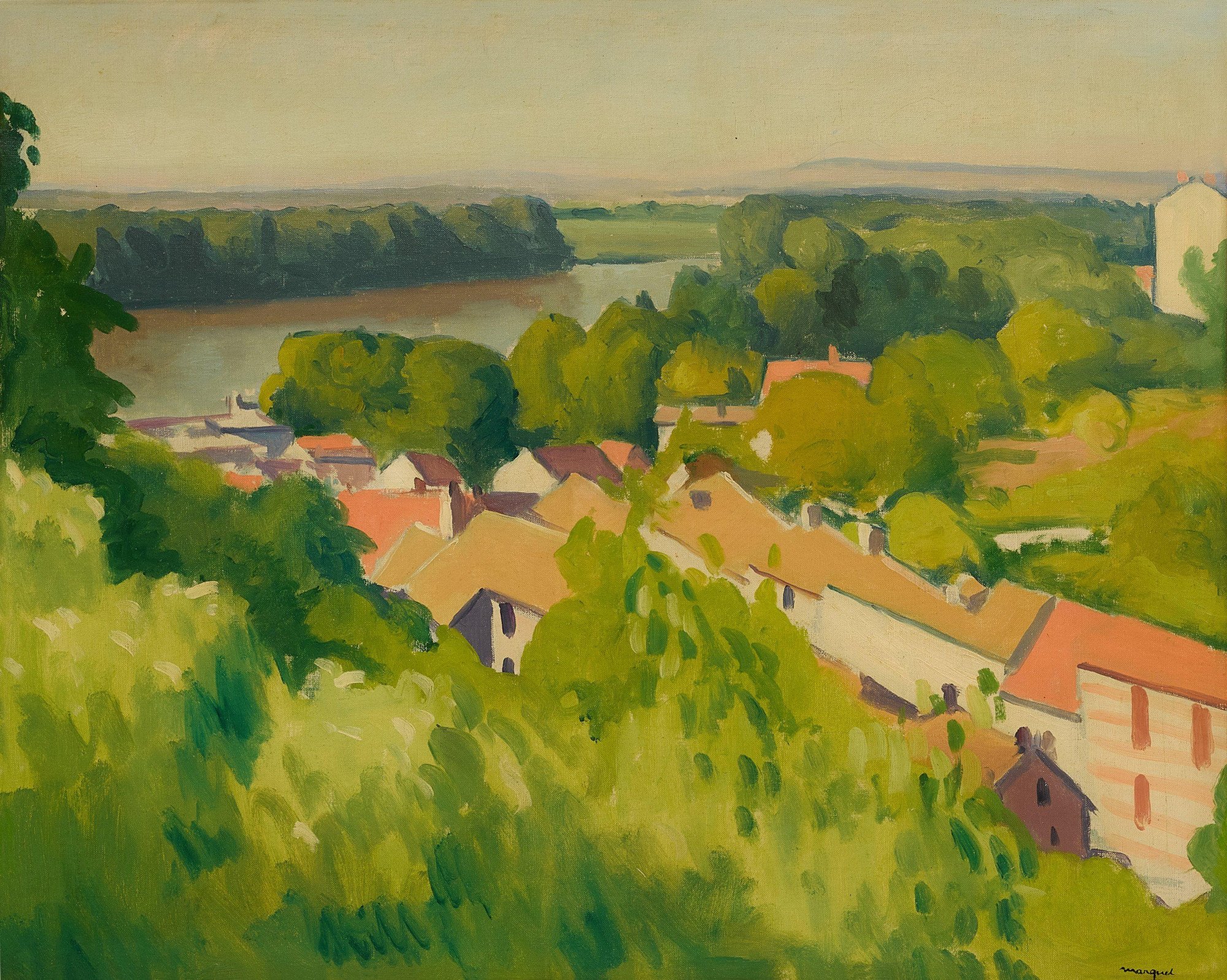
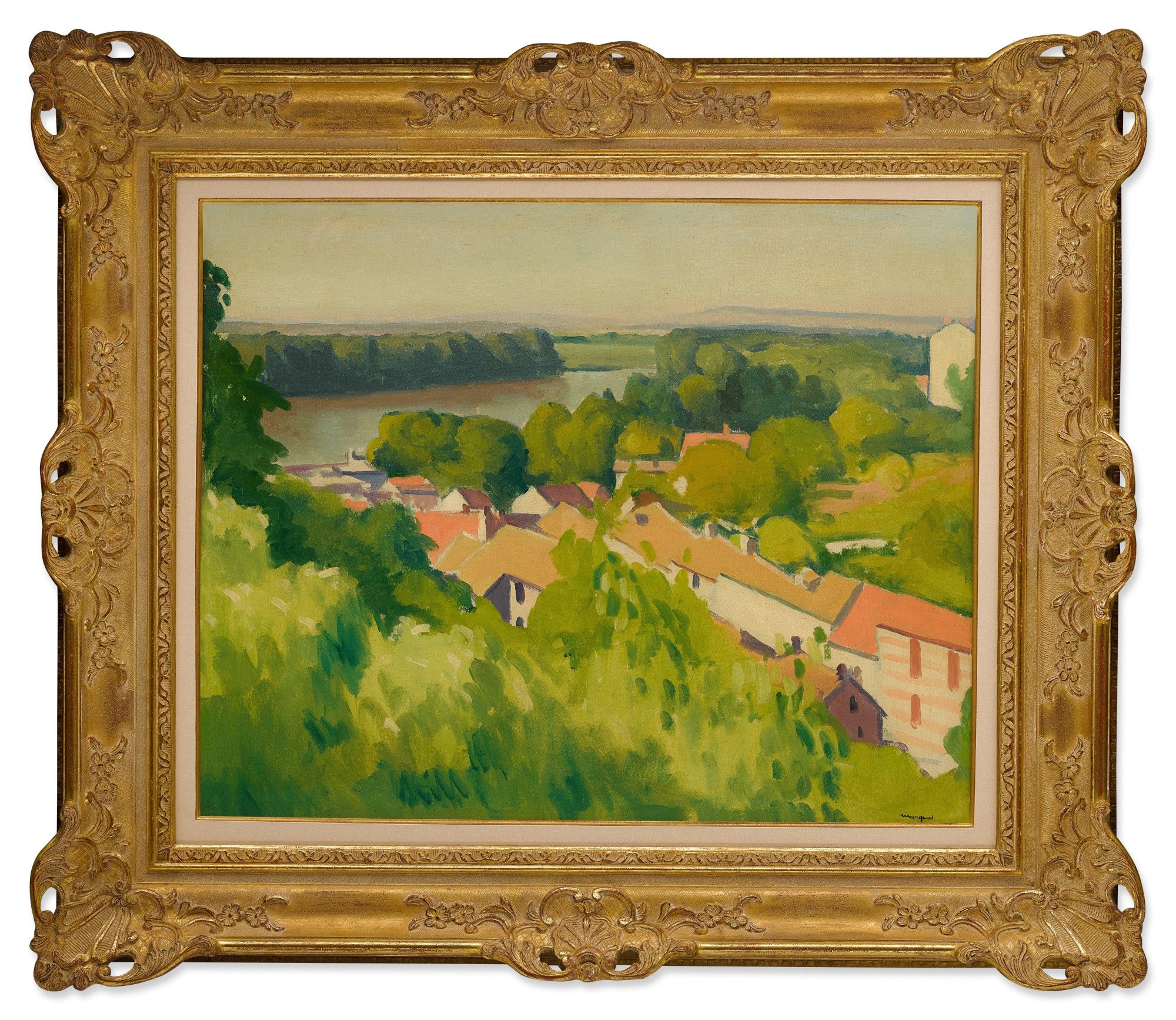
*Le Village d’Herblay, automne* is a serene landscape painted by the French artist Albert Marquet, depicting the quiet riverside town of Herblay during autumn. Painted with soft, simplified forms and luminous color, the work captures a panoramic view of rooftops nestled among abundant greenery, with the broad Seine River stretching across the background.
From an elevated vantage point, Marquet shows the village almost merging with nature. The warm ochre roofs contrast gently with the surrounding greens of trees and hills. The river creates a calm horizontal line that organizes the composition, guiding the eye from the clustered houses toward the distant horizon. The atmosphere feels peaceful and unhurried—typical of Marquet’s landscapes—where subtle color relationships and light take precedence over detail.
The brushwork is loose but controlled. Instead of sharply defining forms, Marquet suggests them through patches of color and simplified shapes. This approach gives the painting a sense of immediacy and calm observation, as if the artist captured the view in a quiet moment overlooking the countryside.
Albert Marquet (1875–1947) was a distinguished French painter associated with Fauvism, though his mature style favored a more subdued naturalism.. Born in Bordeaux, he moved to Paris as a teenager to study at the École des Arts Décoratifs, where he met Henri Matisse, a close companion and artistic influence throughout his life. Early on, Marquet’s works echoed the bold colors and expressive brushwork characteristic of the Fauve movement, as seen in his contributions to the landmark 1905 Salon d’Automne exhibition. Over time, however, he adopted a reserved palette and prioritized atmospheric landscapes, urban scenes, and harbor views, often from high vantage points.
Marquet travelled extensively throughout Europe and North Africa, fueling his lifelong fascination with light, water, and visual harmonies. He lived in Algiers during the Second World War, creating many paintings of the city’s port and verdant surroundings. Renowned for his nuanced compositions, Marquet refused to adhere strictly to artistic theories, instead focusing on capturing the essence of a scene and its atmosphere. His legacy persists as one of the key painters bridging Fauvism and Impressionism, leaving behind a body of work celebrated for its clarity, subtlety, and lyrical beauty.
In *Le Village d’Herblay, automne*, Marquet demonstrates his distinctive ability to transform an ordinary landscape into a calm, luminous scene.
Rather than dramatizing the landscape, Marquet invites the viewer to pause and appreciate the subtle beauty of a rural French village.
Reviews
There are no reviews yet.