


Description
*Henri-Jean Guillaume Martin* was a leading French painter associated with Neo-Impressionism and Symbolism. Born in Toulouse, he studied at the École des Beaux-Arts in Paris and initially worked in a more traditional academic style. Over time, however, he embraced a vibrant, light-filled technique influenced by Divisionism, developing a distinctive manner characterized by mosaic-like brushstrokes and a luminous palette. His mature work combines structural clarity with poetic atmosphere, often depicting idyllic landscapes and scenes from southern France.
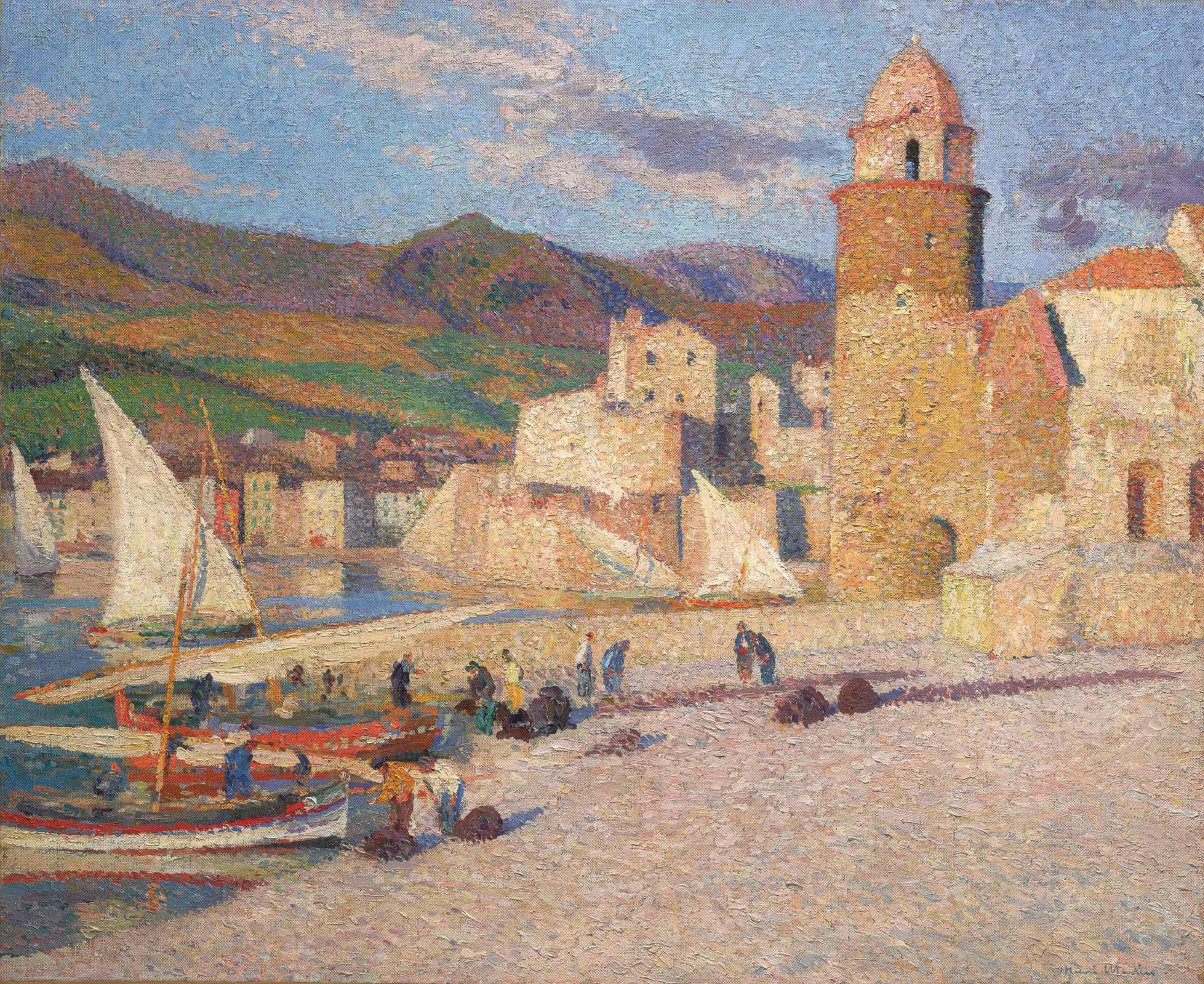
“La Tour de Collioure” (1920) exemplifies Martin’s mature style and his deep sensitivity to Mediterranean light. The painting portrays the picturesque harbor of Collioure, a coastal town in the Pyrénées-Orientales that captivated many artists in the late nineteenth and early twentieth centuries. Dominating the composition is the iconic bell tower of the church of Notre-Dame-des-Anges, rising in warm ochre tones against a softly modulated sky. The surrounding stone buildings, bathed in sunlight, appear almost to shimmer, rendered in a tapestry of small, rhythmic strokes of color.
In the foreground, fishing boats with pale sails rest along the quay, while small figures—fishermen and townspeople—animate the scene with quiet, everyday activity. Rather than focusing on individual detail, Martin dissolves forms into flickering touches of paint, allowing color and light to structure the composition. The mountains in the distance are built from layered hues of green, violet, and blue, enhancing the sense of depth and atmospheric perspective.
The work balances solidity and vibration: architectural forms anchor the scene, while the broken brushwork infuses it with movement and warmth. Martin’s approach transforms a simple harbor view into a lyrical meditation on place, light, and daily life.
Through its radiant color and textured surface, *La Tour de Collioure* reflects Henri Martin’s ability to merge Impressionist light with a decorative, almost pointillist structure—resulting in a vision that is both structured and dreamlike, firmly rooted in the Mediterranean landscape he so loved.
Reviews
There are no reviews yet.