


Description
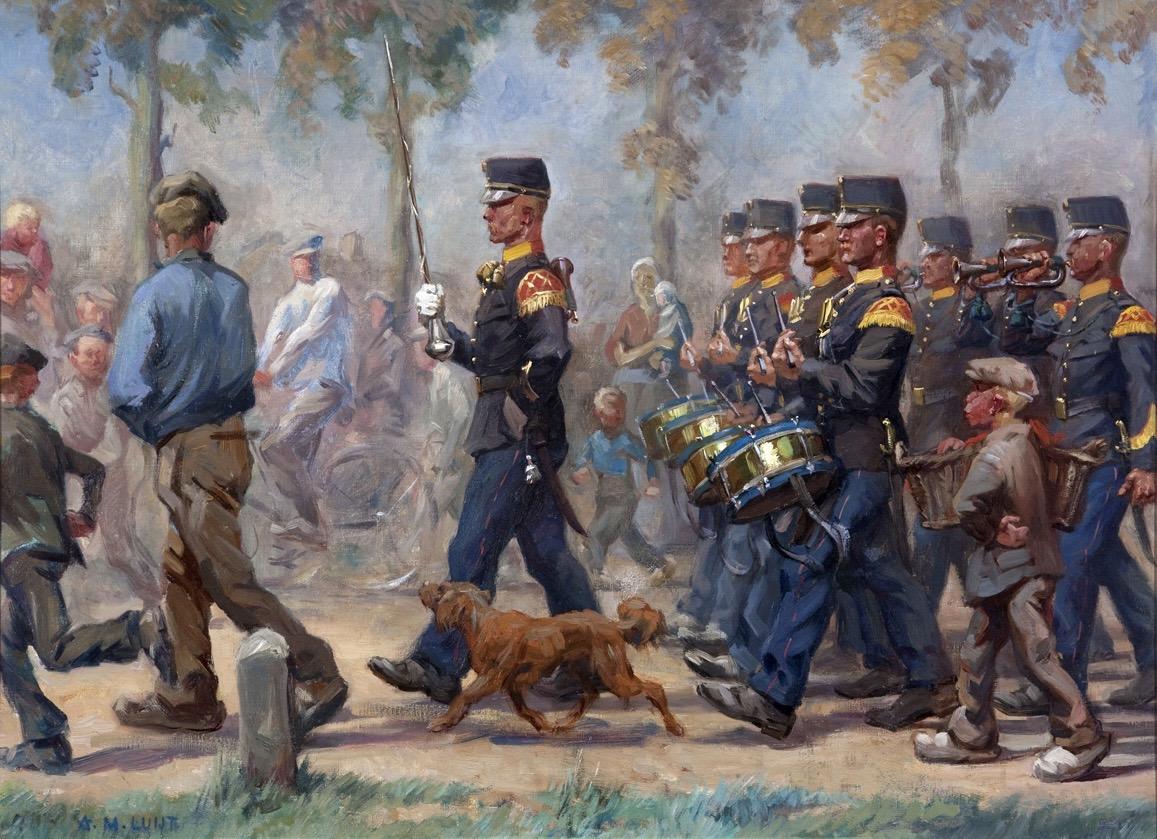
This painting coming from the collecting of our late Queen Juliana (1909–2004) shows us the Marching of the Royal Military Band painted by the Dutch artist Arie Martinus ‘Thies’ Luijt.
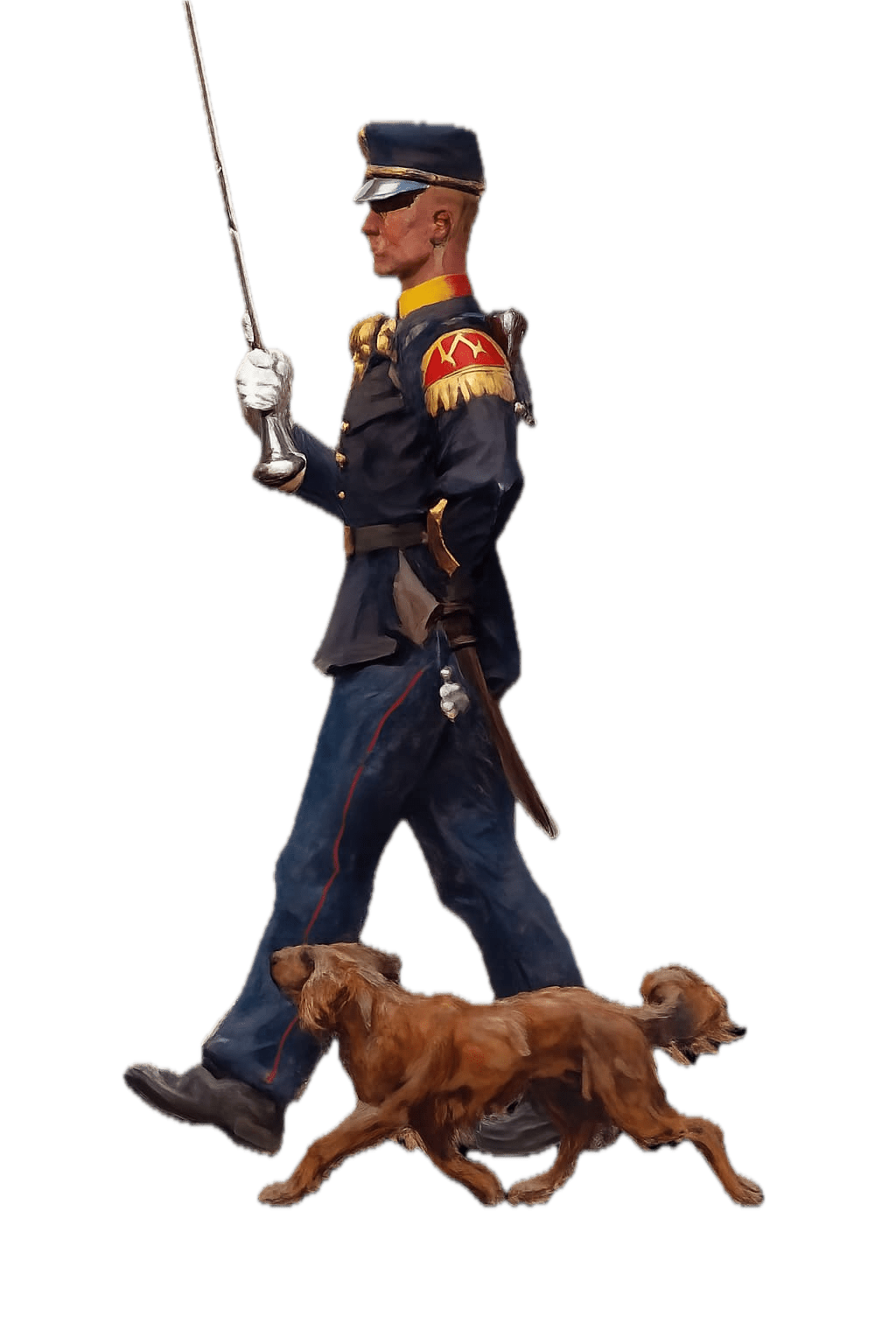
It captures the ceremonial rhythm and atmosphere of a military parade moving through a public gathering. Painted with soft brushwork musicians march in formation while civilians, children, and even a dog animate the composition. The result is both a formal depiction of military pageantry and a lively portrait of communal spectatorship.
Luijt emphasizes motion and sound through loose handling of light and color. The dark uniforms of the band contrast against the hazy pastel background, drawing attention to the musicians as the focal point of the composition. The drummers and marching soldiers appear almost in cadence with one another, while the blurred crowd and filtered daylight create a sense of immediacy, as though the viewer is witnessing the parade in passing. The warm tones and atmospheric treatment soften the militaristic subject.
Thies Luijt was a Dutch painter, illustrator, lithographer, and political cartoonist. Educated at the Academy of Art in The Hague and later at the Académie Julian in Paris, Luijt developed a versatile artistic style that combined technical precision with atmospheric storytelling.
Throughout his career, Luijt lived and worked in several European cities, including Paris and Brussels, where he collaborated with the artists Willem and Albert Roelofs. He also spent a significant period in South Africa before returning to the Netherlands in 1927 and settling in Wassenaar.
Luijt became especially recognized for his paintings of horses and cavalry scenes, often depicting military regiments, riders, and coaches with vivid movement and refined detail. He was a member of prominent Dutch art societies including Pulchri Studio and the Haagse Kunstkring. An internationally active artist, Luijt also gained distinction through his participation in the Olympic art competitions of 1928, 1936, and 1948. At the 1948 London Olympics, he received an honorable mention for his painting *Polo Game*.
The Marching of the Royal Military Band comes from the property from the estate of Queen Juliana of the Netherlands, presumable from the Palace Soestdijk where Queen Juliana lived throughout her married life.
Reviews
There are no reviews yet.