


Description
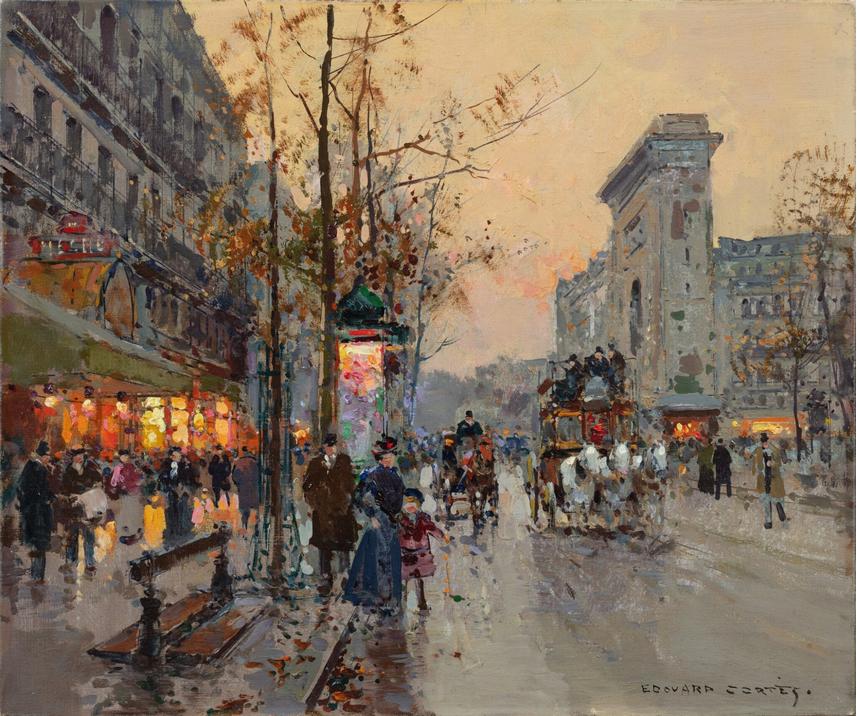
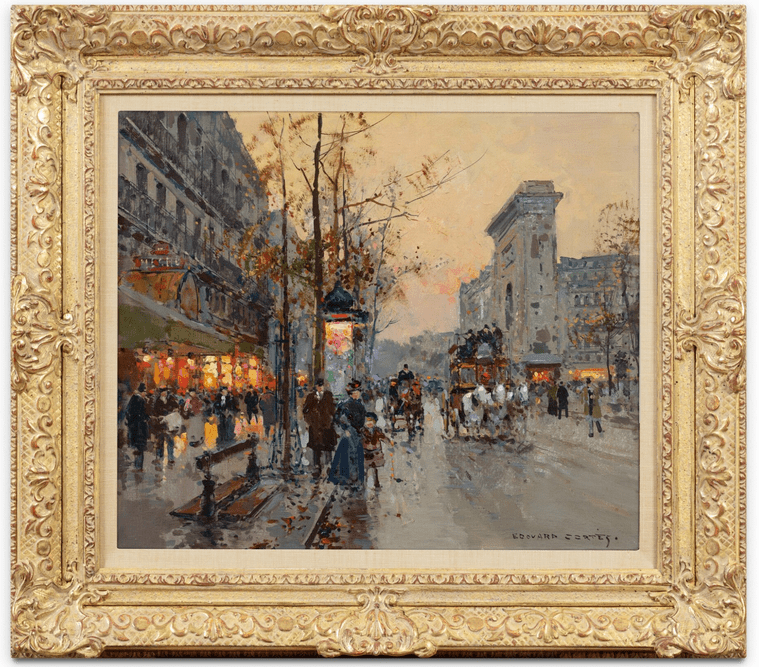
This atmospheric Paris street scene, *La Porte Saint-Denis*, exemplifies Edouard Cortès’ gift for capturing the poetry of everyday urban life at the turn of the century.
Cortès depicts the monumental Porte Saint-Denis rising at the end of a busy boulevard, its stone façade softened by a misty evening light. The wet pavement reflects shopfronts, carriage lamps and illuminated advertising kiosks, so that the entire surface of the street seems to shimmer with movement and color. Figures stroll, converse and hurry past in small groups, while elegant horse‑drawn omnibuses advance toward the viewer, anchoring the composition in the rhythm of modern city life.
His loose, flickering brushwork and broken touches of orange, rose and violet recreate the luminous haze of dusk over Paris, recalling Impressionist investigations of light but with a more narrative, anecdotal focus. Cortès balances the verticals of the trees and buildings with the strong diagonal recession of the boulevard, drawing the eye into depth and giving the viewer the impression of standing on the pavement amid the crowd.
The Porte Saint-Denis itself, a 17th‑century triumphal arch marking one of the historic entrances to Paris, appears here not as a cold monument but as part of a lived, contemporary environment. Cortès emphasizes the convivial bustle of cafés and shop windows, whose warm glow spills onto the street and contrasts with the cool dampness of the paving stones and bare autumn trees. The scene evokes Belle Époque Paris, with its mixture of tradition and modernity—gaslit evenings, promenading bourgeois families, and horse traffic edging toward the age of automobiles.
Edouard Léon Cortès was born in Lagny-sur-Marne in 1882 into a family of artists; his father Antonio Cortès was a Spanish painter who had settled in France. Admitted to the Paris Salon in 1899 while still in his teens, Edouard quickly gained attention for his urban scenes and by the early 1900s was exhibiting Paris boulevards at dusk and in snow, subjects that would become his lifelong signature. He became associated with the Société des Artistes Indépendants and other exhibiting societies, maintaining a steady presence on the French art market.
Throughout his career Cortès focused almost exclusively on Paris and its environs, repeatedly painting landmarks such as the Boulevard de la Madeleine, the Opéra, the Porte Saint-Denis and the Place de la République in different seasons and times of day. His style remained rooted in post‑Impressionism: animated brushwork, luminous palette and a concern for atmospheric effects, combined with a clear, legible depiction of everyday urban life.
Reviews
There are no reviews yet.