


Description
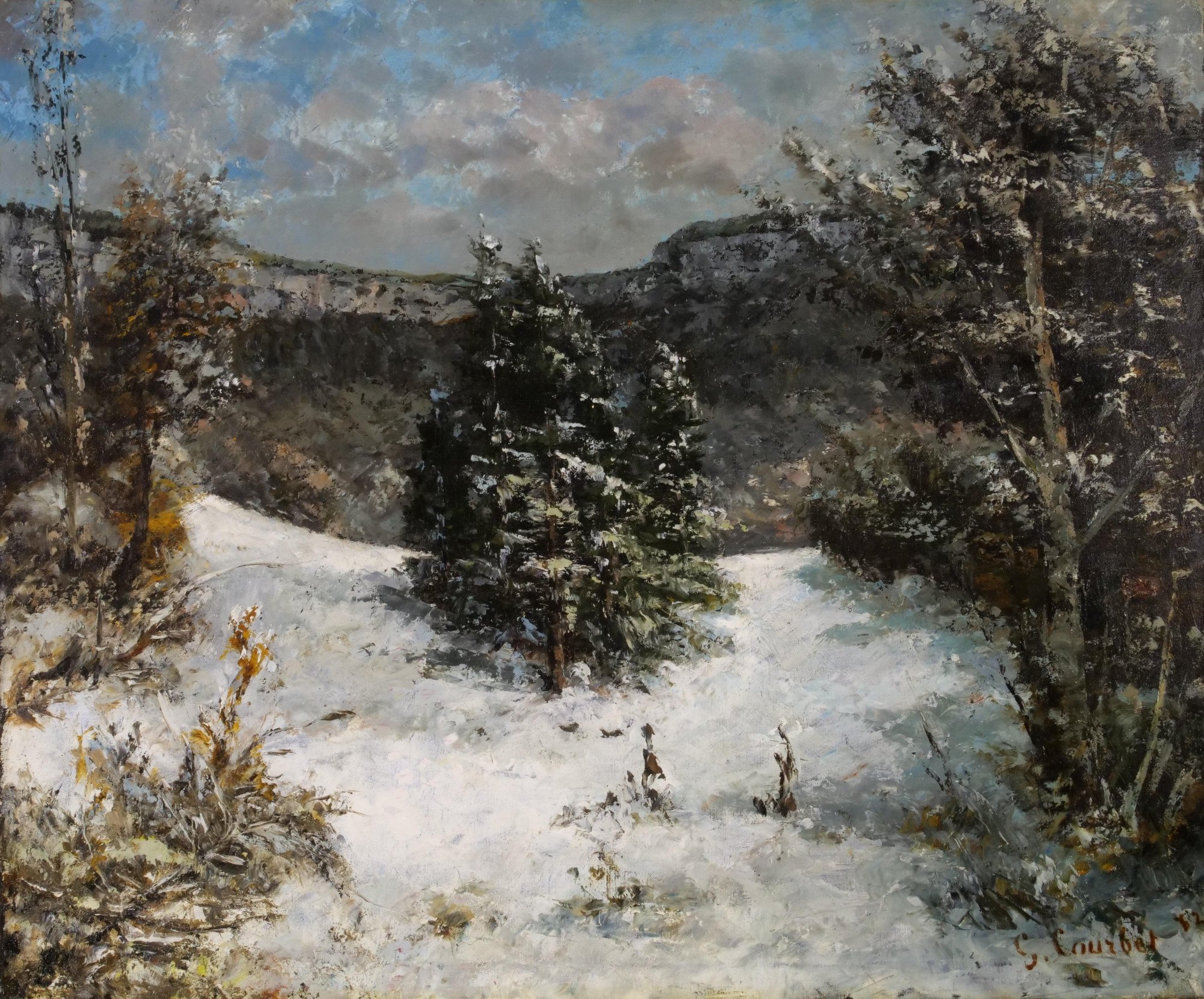
“Passage de Neige” (Snowy Landscape) by the world famous Gustave Courbet is a masterful example of Courbets skills, capturing the raw and tactile experience of a winter scene. Courbet was particularly drawn to representing the ephemeral, ever-changing quality of snow and the stark beauty of the wintry countryside.
Courbet’s landscapes, especially his snow scenes, stand out for their empirical fidelity and distinctive textures. He layered his canvases with thick, expressive brushwork and sometimes used palette knives, sponges, and rags to evoke the varied surfaces of snowy ground, icy branches, and clouded skies. In “Passage de Neige,” viewers are drawn into a serene, chilly world where the blanket of snow dominates, offset by dark evergreen trees and the subtle hues of winter—steely blues, browns, and dusk-like greys.
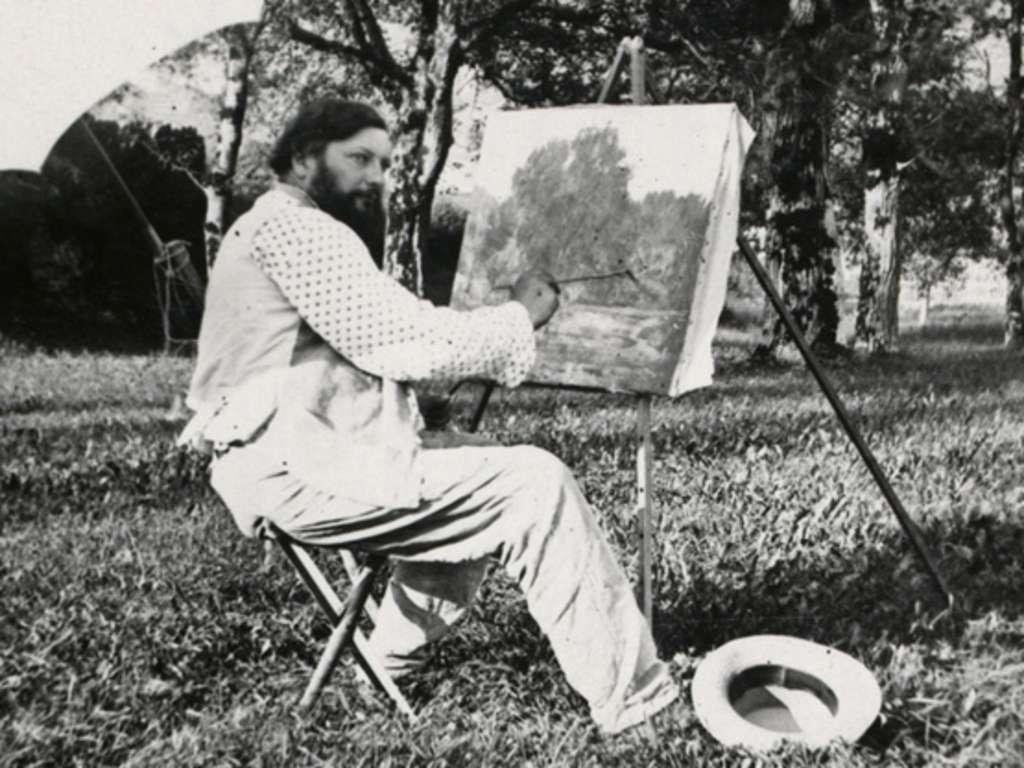
Gustave Courbet was a pioneering French painter and the leading figure of the Realism movement in 19th-century art. Born in Ornans, France, in 1819, Courbet rejected both the idealized traditions of Classicism and the emotional excesses of Romanticism, instead aiming to depict the world as it actually appeared, with all its imperfections. Courbet occupies an important place in 19th-century French painting as an innovator and as an artist willing to make bold social statements through his work.
Courbet achieved his first Salon success in 1849 with his painting After Dinner at Ornans. The work earned Courbet a gold medal and was purchased by the state. The gold medal meant that his works would no longer require jury approval for exhibition at the Salon—an exemption Courbet enjoyed until 1857 (when the rule changed)
Courbet was known for his direct, earthy palette and his innovative use of palette knives, creating bold textures and a sense of materiality in his landscapes, portraits, and still lifes. He influenced a generation of later artists, including the Impressionists.
A committed Republican, Courbet was politically active during the tumultuous times of the Paris Commune in 1871. His involvement led to his imprisonment and later exile in Switzerland, where he spent the last years of his life before his death in 1877.
According to the Sotheby’s auction catalog, Jean Jacques Fernier, the Courbet expert, dated this work to 1876 in a letter from March 4, 1991. During Courbet’s exile in Switzerland, he painted dramatic Alpine landscapes and tranquil lake scenes, marked by expressive brushwork and a deep sensitivity to nature. He smuggled these anonymously painted works out of the country to his studio in Ornans, under which “Payssage de Neige”. There, these works were signed with Courbet’s signature by his student Cherubino Pata. This painting is a typical Swiss forest landscape from Courbet’s powerful later period.
He was in exile because he was sentenced to reimburse the cost of rebuilding the column on the Place Vendôme. The column had been toppled by revolutionaries in 1871, allegedly incited by Courbet because of his affiliation with anarchist ideas. He fled to Switzerland and died there, never having paid any compensation
Courbet’s legacy lies in his insistence on artistic sincerity and observation, which reshaped the direction of modern art and provided inspiration for generations of avant- garde painters.
Courbet’s works are displayed in major museums around the world like the Musée d’Orsay, Louvre Museum and the Metropolitan Museum of Art.
In his hometown region, the Musée Courbet in Ornans houses around 60 of his works, offering a comprehensive view of his artistic evolution from youthful works to powerful later pieces
DID YOU KNOW……….That Courbet’s most expensive painting ever sold at auction is “Femme nue couchée” (1862), which is sold in 2015 for over $15 million.
Another famous and considered priceless painting is L’Origine du monde, one of the most provocative and discussed masterpiece in art history.

Reviews
There are no reviews yet.