


Description
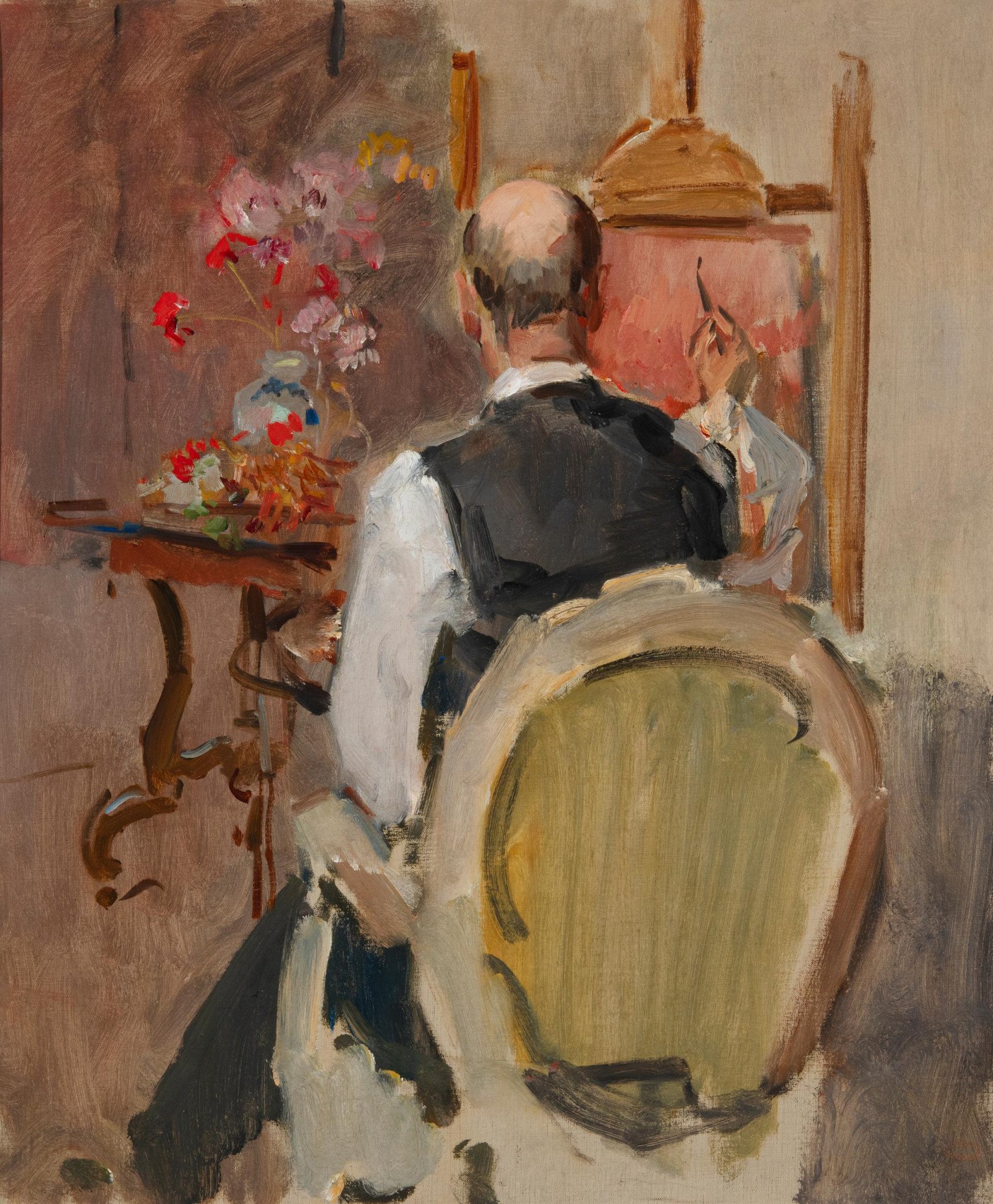
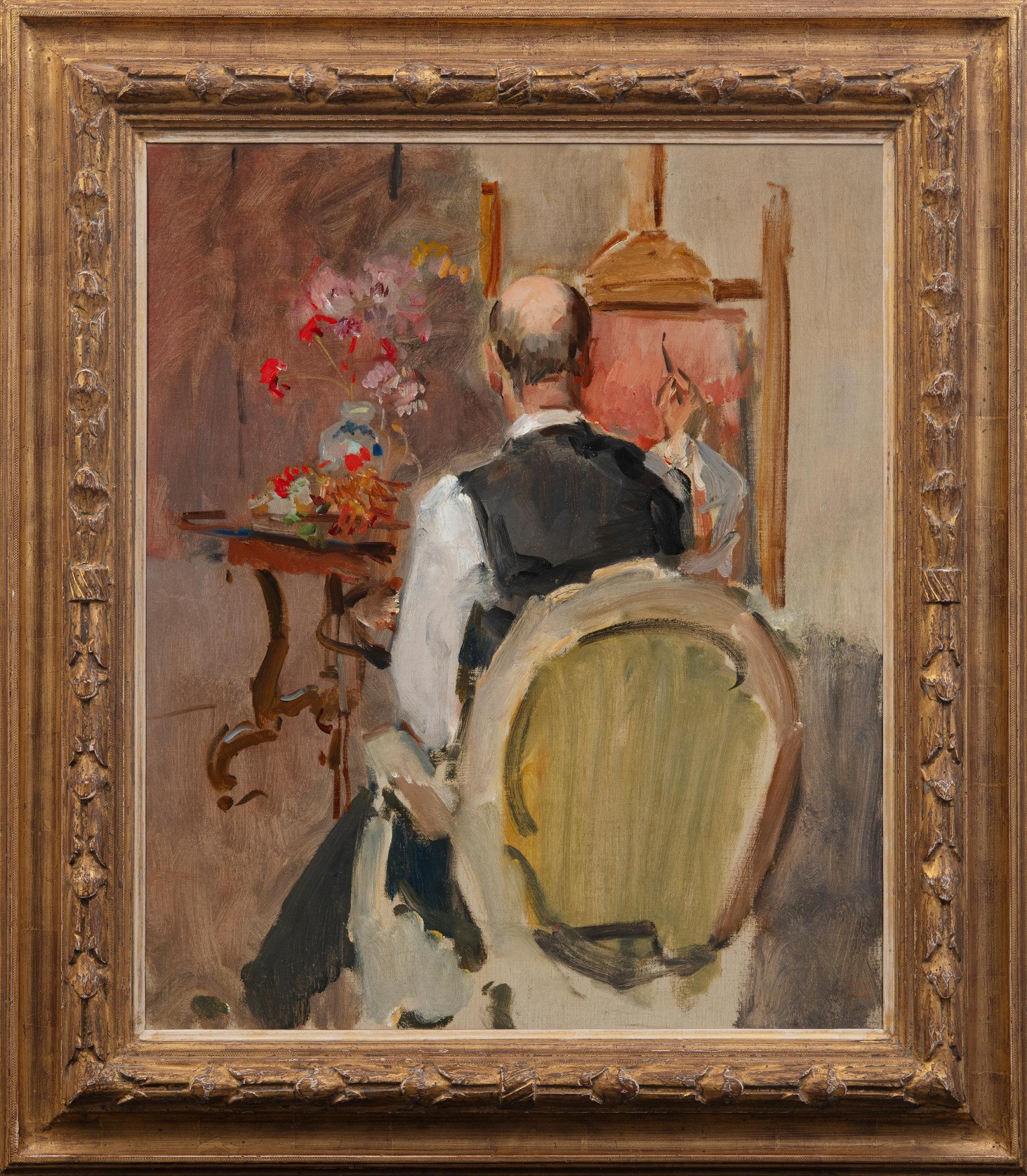
With this painting the famous Dutch artist Isaac Israëls offers an intimate glimpse into the world of the artist Marius Bauer (1867 – 1932) at work. Rather than presenting his fellow painter as a formal portrait sitter, Israels captures Bauer absorbed in the creative process, seated before his easel.
Seen from behind, Bauer becomes part of the studio environment: his dark jacket and pale sleeves are set against the warm, muted tones of the room, while the vivid flowers and decorative objects on the table provide color. Israels’ loose, spontaneous brushwork gives the scene a sense of immediacy, as though the moment has been observed and painted almost in passing.
The relationship between the two artists lends the work a particularly personal character. Israëls and Marius Bauer had known one another since their student years at the Academy of Fine Arts in The Hague, where they studied together between 1878 and 1880. Their friendship remained an important one throughout their lives.
Bauer, best known for his evocative depictions of the Middle East, North Africa and Asia, had travelled extensively and developed a highly individual Orientalist style. Israels, by contrast, became one of the leading figures of Dutch Impressionism, renowned for his lively observations of everyday life and his expressive, fluid handling of paint.
This painting brings these two artistic worlds together within the intimate confines of Israels’ studio. The viewer is placed almost directly behind Bauer, sharing his perspective and becoming a quiet observer of the creative act.
More than simply a portrait of a fellow artist, it is a tender tribute to friendship, artistic companionship and the creative process itself.
Isaac Israëls was the leading representative of the group of Amsterdam Impressionists. He painted fragments of life he chanced across in the capital’s shopping streets, coffee houses and café-chantants, where busy urban living was played out. In a few apt charcoal lines or quick, spontaneous brushstrokes, with subtle color accents, he captured everything he saw.
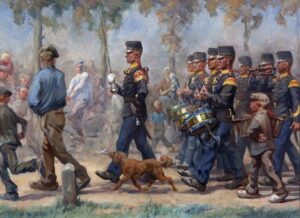
Between 1880 and 1882 he studied at the Royal Academy of Art, The Hague, where he met Marius Bauer who was to become a lifelong friend. In 1881, when he was 16, he sold a painting, Bugle Practice, even before it was finished to the artist and collector Hendrik Willem Mesdag. Starting 1878, Israëls made annual visits to the Salon des Artistes Français with his father and in 1882 made his debut there with Military Burial. In the 1885 Salon he received an honourable mention for his Transport of Colonial Soldiers.
Towards the end of the century, Israëls was introduced by his childhood friend and portrait painter Thérèse Schwartze to the Amsterdam fashion house Hirsch & Cie (nl)at the Leidseplein. Israëls portrayed the whole range of the world of haute couture, from seamstress to wealthy client, gaining access even to the fitting-rooms.
Israëls moved to Paris in 1904, establishing his studio near Montmartre and just yards away from the studio of Henri de Toulouse-Lautrec whom he admired, as he also did Edgar Degas. As in Amsterdam, he painted the Parisian specific motifs: the public parks, cafes, cabarets and bistros, as well as such subjects as fairgrounds and circus acrobats. Likewise he sought out the fashion houses Paquin and Drecoll to continue his studies of the world of fashion.
At the outbreak of the First World War he was living in London, where he found new subjects in horse-riding at Rotten Row and in ballerinas and boxers. He returned to Holland for the duration of the war, living alternately in The Hague, Amsterdam and Scheveningen, where he worked primarily as a portrait painter. Amongst his sitters was Magaretha Gertrud Zelle, better known as Mata Hari, executed as a spy in France in 1917.
According to Wagner (1967), in early 1919 Israels was admitted to the Zuidwal Hospital for foot surgery. Despite the inconvenience, he worked as much as he could. Because his mobility was limited, the artist turned to subjects that remained accessible to him. Still lifes of flowers appear frequently in his sketchbooks from this period. He also produced several paintings with the same subject, including one depicting the floral arrangements featured in this painting.
Reviews
There are no reviews yet.